NFL Best Ball: DraftKings Early Bird Best Ball Draft Recap + Analysis
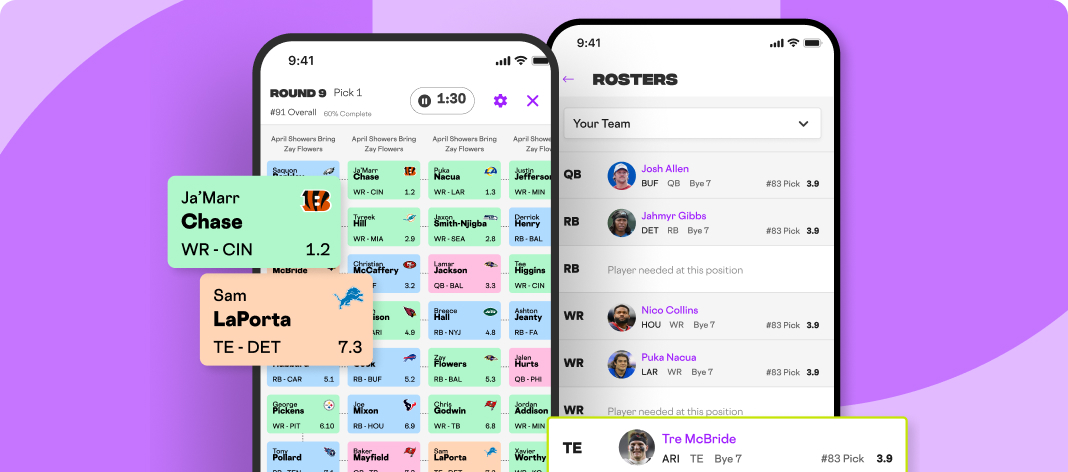
DraftKings Best Ball contests are already live and rolling in advance of the 2026 NFL season. Earlier this week, I livestreamed a draft over on the RotoWire Fantasy Football YouTube channel and gave my thoughts as it unfolded.
Now's a great time to get started on your best ball journey for 2026, with several key offseason milestones still to come, like free agency and the NFL Draft. We constantly update our best ball cheat sheets and fantasy football rankings for every format, including the DraftKings Best Ball cheat sheet.
Try DraftKings Early Bird Best Ball Today
Best Ball Draft Results
Check out the draft board below. I picked out of the second spot.

My Roster
| Player | Position | Pick | |
|---|---|---|---|
| Puka Nacua | WR | 1.2 | |
| Chris Olave | WR | 2.11 | |
| George Pickens | WR | 3.2 | |
| Quinshon Judkins | RB | 4.11 | |
| RJ Harvey | RB | 5.2 | |
| Trevor Lawrence | QB | 6.11 | |
| Kyle Pitts | TE | 7.2 | |
| Xavier Worthy | WR | 8.11 | |
| Jadarian Price | RB | 9.2 | |
| Tyler Shough | QB | 10.11 | |
| Brenton Strange | TE | 11.2 | |
| Kayshon Boutte | WR | 12.11 | |
| Chimere Dike | WR | 13.2 | |
| Sean Tucker | RB | 14.11 | |
| Nicholas Singleton | RB | 15.2 | |
| Elijah Sarratt | WR | 16.11 | |
| Shedeur Sanders | QB | 17.2 | |
| Eli Stowers | TE | 18.11 | |
| Ollie Gordon | RB | 19.2 | |
| Devontez Walker | WR | 20.11 |
Grading My Team
I went with a WR-heavy start, anchoring my team with three studs at that position. Last year was not a great year for such a strategy, as early-RB teams ruled the day for the most part. However, I broke down general wide receiver performance in best ball in a recent article and found that wide receivers have proven to be safe commodities in the early going.
It's pretty remarkable how stable the top of the receiver position has been year over year. On average, a receiver taken in the first round of best ball drafts has returned 9.37 usable weeks during the fantasy regular season.
That's 2.34 more usable weeks than what first-round running backs have produced on average. The bar's a little higher for a running back (RB18), but there's reason to believe that the receivers available to you in the first round are going to give you a really strong starting point to your roster.
That's not to say that it extends all the way to the second and third rounds, though.


What's interesting is the dropoff severity from Round 1 to Round 2 for receivers compared to RBs. For receivers, the average usable weeks variable drops from 9.3 to 6.8. For running backs, it only drops from 7.04 to 6.46.
Anyway, the new market shape and bigger emphasis on running backs going early mean a couple of things. At once, skipping RB until round 4 likely puts me behind the curve at that position. However, I also have a distinct advantage in my receiver room and the true WR1 types are becoming rarer as teams shift back to running the ball more and using more tight ends.
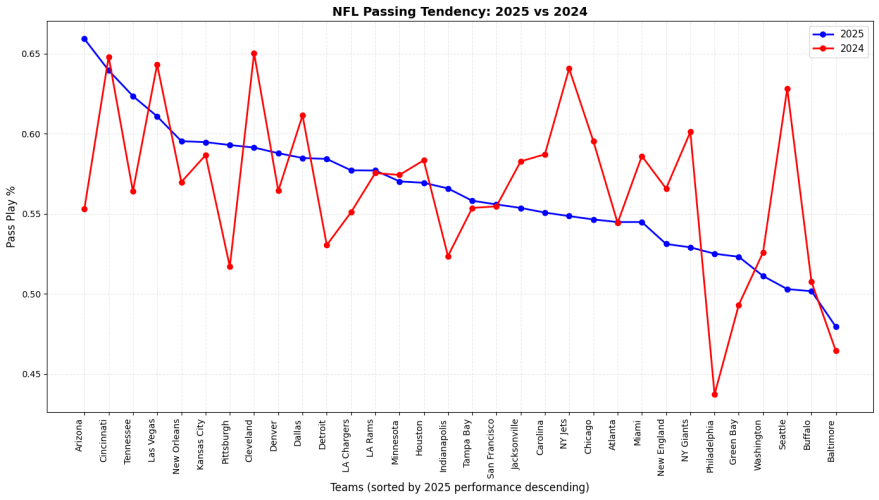
Half of the league passed less in 2025 than in 2024. Some cases were extreme like Seattle, Cleveland, Jets, Giants and Bears all ran it at a significantly higher rate in 2025, obviously with varying degrees of success.
Like I was saying above, there is a growing emphasis in two-tight end sets. Using some data from Sumersports, I found that 12 personnel usage has grown from ~19% in 2023 to about 22% each of the last two years.
More tight end reps usually comes at the expense of WR reps, specifically WR3 types.
This is all a fancy way of saying I want to make sure my DraftKings best ball build have a strong base of elite receivers at the start.
A Nacua-Olave-Pickens start accomplishes that.
Running Backs
Onto the running backs, it's a bit of an uneasy feeling having Quinshon Judkins and R.J. Harvey as my top 2. Judkins showed he has top 10 potential but is coming off of a pretty serious ankle injury and new coach Todd Monken has a big mess to clean up with the rest of the offense. Harvey had a solid rookie season, though his usage was a source of frustration for his investors. Here's hoping Denver commits to him more this year with a full season under his belt.
There seems to be a clear tier drop after the guys in Harvey's cluster (Javonte Williams, D'Andre Swift, TreVeyon Henderson and Jaylen Warren). A full round and a half went by before the next one (Bhayshul Tuten) was selected. I left those backs alone, though I would have considered Kyle Monangai in the 8th if he had fallen to me (he went 8.5).
Still, two running backs through eight rounds had me feeling uneasy. I went ahead and nabbed Notre Dame rookie Jadarian Price at the top of the ninth, hoping that a big combine weekend from him would get me some instant closing line value on him. I think there's a chance he's drafted as the RB2 in this class with Day 2 draft capital assuming his testing is as good as I'm expecting.
Unsurprisingly, the running back options later in the draft weren't exactly ideal. It's hard to thread the needle and squeeze out usable weeks from running backs after the 14th round. That's been proven year-over-year in these best ball contests. But I had to try.
I backfilled my RB room with Sean Tucker (14.11) and Nicholas Singleton (15.2) before throwing a dart on Ollie Gordon with my second-to-last pick. Tucker has a chance to move up on the depth chart this season assuming Rachaad White leaves in free agency. He's not going to replace White's pass-catching production 1:1, but he profiles better than Bucky Irving in red zone situations. As it stands, Tucker has legitimate contingent upside to far outproduce his ADP. We'll just have to see what the Bucs do at running back if/when White signs elsewhere.
Singleton is an incoming rookie out of Penn State with plenty of pedigree as a former five-star recruit who is built like a workhorse (6-0, 227) who racked up 45 rushing touchdowns and 102 receptions in college. He runs a little hot-and-cold and suffered a broken foot at the Senior Bowl so we won't get combine metrics, but in a class this thin at the position, he's not going to get lost in the shuffle. Late Day 2 draft capital will boost his ADP.
Tight Ends
Yes, I drafted Kyle Pitts ahead of ADP.
I followed that up with Brenton Strange (11.2) and Eli Stowers (18.11). Three tight end builds are something I try to target on DraftKings given the volatility of the position and the deeper 20-round format. The window on Stowers going this late might be closing as of Friday so I've been trying to get as many shares as possible.
I wrote more in-depth on Stowers in my Rookie Tight Ends article here on the site.
Quarterbacks
This is likely the weak spot in my build. My QB room consists of Trevor Lawrence (6.11), Tyler Shough (10.11) and Shedeur Sanders (17.2). Basically, I'm going to need Lawrence to repeat his 2025 in order to stay afloat there. I didn't build full stacks with any of them, but they all have correlating pieces with Brenton Strange and Chris Olave also on my roster, along with Quinshon Judkins. You know, gotta load up on that Browns offense however you can.
Overall DraftKings Best Ball Draft Analysis
- Running Backs Go Early and Dry Up Quick: Fading RB with my first pick and having a draft slot on the end did not leave me many options by the time I was up again with the 23rd pick. 11 running backs went off the board from 1.3 to 2.11. It feels like there's a pretty big dropoff from Derrick Henry to the next tier (Irving, Hall, Walker, Jacobs) so I steered into the skid and loaded up at WR. Big lesson learned is that if you draw an early draft slot, be prepared to get creative with your picks at the 2-3 turn.
- Waiting on Quarterback is No Longer Viable: Last year was the year to wait on QB. The top of the position was littered with landmines like Lamar Jackson, Jayden Daniels and Patrick Mahomes.
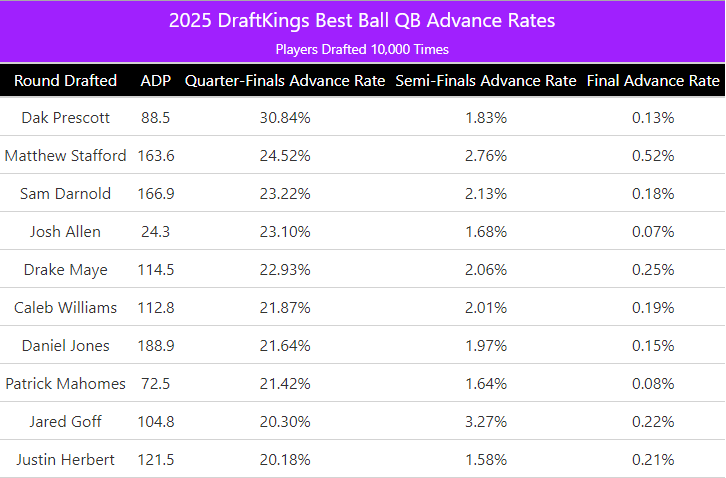
Look at the ADP of the top advance rate quarterbacks from last year on DraftKings. Outside of drafting Josh Allen, you were far better off waiting and grabbing a quarterback in the 10th round or later.
We don't have that luxury this year. Premium quarterbacks like Allen and Jackson are still priced up, but that gap between them and the second or even third tier has shrunk dramatically. 10 quarterbacks had ADPs inside the top 100 last year. This year? 10 go inside the top 80, and 16 inside the top 100.
That's not to say there aren't decent quarterback options still available to you after that point. I like Tyler Shough obviously and feel like Sam Darnold (12.2) and Cam Ward (13.6) are still values.
3. Don't sleep on the late receivers: You inherently have a much better chance at getting usable weeks out of late-round receivers than you do running backs. There are fewer obstacles to them getting on the field and drawing somewhat reliable target shares. It's not the same as a running back fighting for scraps and biding his time to move up a spot on the depth chart.
Historically, the market is going to overlook a handful of guys with round 18 ADPs or later. Not to say I've already found this year's Puka Nacua or anything but the endgame is where WR gems can be unearthed.
Some late WR values I liked from this draft included Ryan Flournoy, Zachariah Branch, DeMario Douglas, Devontez Walker, and Hollywood Brown. Kyle Williams, Jaylin Lane and Eric McAlister were all in my queue when the draft ended as well.