Fantasy baseball is all about roster balance. The goal is to accumulate the best MLB player stats in as many categories as possible, but that requires more than just blind roster building. Knowing how to position your team so you have balance, risk against injuries and the potential to find value with end-of-the-bench players all factor into building a successful roster.
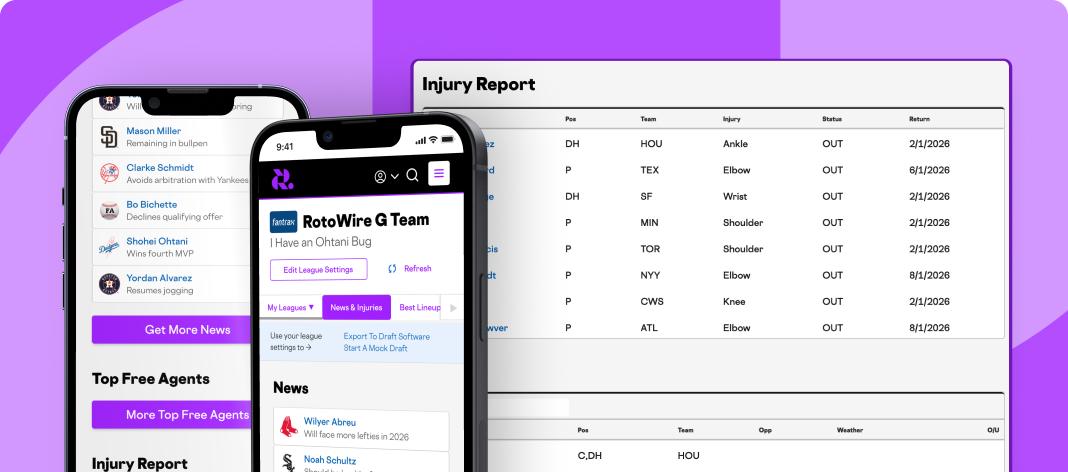
Building that great team is about more than just looking at fantasy baseball rankings and taking the top player on the list each time you select. It's also dependent on your specific league settings, meaning you'll need to dive into custom rankings and then decide how you're going to fill out your roster. You'll need to look beyond the required positions toward spots that give you strength across the board. That's why it's important to trust the RotoWire experts and tools to help you plot the best roster strategy.
Why Roster Construction Matters in Fantasy Baseball
There are 10 different positions in fantasy baseball (all nine fielding spots plus a designated hitter), and pitchers can be broken into starters and relievers. That's more choices than in any other sport, requiring savvy drafting and roster management throughout the season.
If you forget about a position or two, you'll be stuck with bottom-feeders that don't accrue as many counting stats as you'd like and hurt you in percentages. Go overboard on another position and you won't necessarily have a spot to play some of them on a given day. Balance is
Fantasy baseball is all about roster balance. The goal is to accumulate the best MLB player stats in as many categories as possible, but that requires more than just blind roster building. Knowing how to position your team so you have balance, risk against injuries and the potential to find value with end-of-the-bench players all factor into building a successful roster.
Building that great team is about more than just looking at fantasy baseball rankings and taking the top player on the list each time you select. It's also dependent on your specific league settings, meaning you'll need to dive into custom rankings and then decide how you're going to fill out your roster. You'll need to look beyond the required positions toward spots that give you strength across the board. That's why it's important to trust the RotoWire experts and tools to help you plot the best roster strategy.
Why Roster Construction Matters in Fantasy Baseball
There are 10 different positions in fantasy baseball (all nine fielding spots plus a designated hitter), and pitchers can be broken into starters and relievers. That's more choices than in any other sport, requiring savvy drafting and roster management throughout the season.
If you forget about a position or two, you'll be stuck with bottom-feeders that don't accrue as many counting stats as you'd like and hurt you in percentages. Go overboard on another position and you won't necessarily have a spot to play some of them on a given day. Balance is key.
"With a well-balanced roster that has a surplus at every position, you'll be able to withstand an early injury and can easily cut a late-round pick who starts the year poorly, because his replacement is already on your roster," said RotoWire baseball expert Erik Halterman. "That means you can spend your efforts on waivers chasing after the best available players rather than limiting yourself to filling in holes."
How League Settings Influence Positional Needs
The set-up of your league is critical when determining how to build your roster. Inputting those settings and using the RotoWire fantasy baseball draft assistant should help lead you to success. League settings that include additional points for home runs mean you'll want to load up on sluggers. If you're in a head-to-head league with no designation for starters and relievers, you may want to avoid saves and load up on starters to win those categories. Be sure to check the RotoWire articles on draft strategy when weighing these decisions.
Two-catcher leagues are rare, but if you're in one you won't want to wait on grabbing your first one considering 24 (in 12-team leagues) are guaranteed to go off the board over the course of the draft. If your league has multiple IL spots available for you to use, you can more safely draft IL-eligible players. All these factors should play into how you build your team on draft day and maintain it throughout the season.
Weekly lineups vs. daily lineups will also influence the makeup of your team, with Halterman noting that daily lineup leagues mean you can more easily stream pitchers who have favorable matchups off the waiver wire. With weekly lineups, you'll need to be more strict about building a bench with reliable starters.
"In most weekly leagues, you ideally want to fill most of your bench with starters, giving you the option to choose the guys with two-start weeks and friendly matchups," he said.
Typical Positional Breakdowns in Fantasy Baseball Drafts
Most fantasy baseball leagues will require you to start at least one player at the eight non-pitcher fielding positions. Some leagues will have a corner infield (1B/3B) slot and middle infield (2B/SS) slot. More will have utility positions where managers can plug in DHs or any other players of their choosing.
On the pitching side, rosters are typically split between starting pitching and relievers. Some starters have relief pitcher eligibility (and vice versa) and can have added value in those types of leagues. Other leagues simply have slots for pitchers, meaning you can decide if you want to go heavy on starters, balance it out with two or three relievers, or go heavy on saves if your league settings reward that. Again, balance remains key, and players who are eligible at multiple positions also gain added value.
"With enough multi-eligible hitters, I can usually accomplish that while only dedicating a spot or two to hitters, leaving the rest of my bench for starting pitchers, aside from perhaps a single closer spec if I'm not happy with the closers in my active lineup," Halterman said.
RotoWire's fantasy baseball draft kit has analysis and breakdowns on all players so you can target the right ones based on your league's settings.
How Draft Trends Affect Position Depth
One popular theory is not to worry about positions early in your draft. There'll still be enough depth out there after the first few rounds that you won't be in a tough spot later if you draft solely based on value. Draft based on RotoWire's fantasy baseball ADP to get the league's best players on your squad.
It's typical to have a run on a more scarce position, such as catcher, second base or closer. When this happens, the RotoWire experts will tell you it's OK to push other players at those positions up your board a few slots so you're not picking through the trash when it comes time to address that position.
How Managers Approach Position Planning on Draft Day
It's good to run through a fantasy baseball mock draft or two prior to draft day to get a sense of when players are going off the board (or how much they're going for in auction leagues). This isn't a guarantee, but it gives you a feel for whether players you like are available at certain positions after the first few rounds.
Managers who have a sense of the expected ranges of players can then adjust their rankings or their fantasy baseball auction values to be better prepared. Have a plan, a backup plan and then another. At the end of the day, the goal is to build a roster with the best players, regardless of position.
"In most leagues, I'll enter the draft knowing that I'll want to end up with one extra option for each position," Halterman said. "But beyond that, I won't put that much thought into what position I'll draft when, because I'd rather play the draft as it falls to me."
Draft day never plays out as you'd expect, so being prepared for a variety of scenarios. This will help you build a balanced team. And remember to check RotoWire's expert tools to make informed decisions.