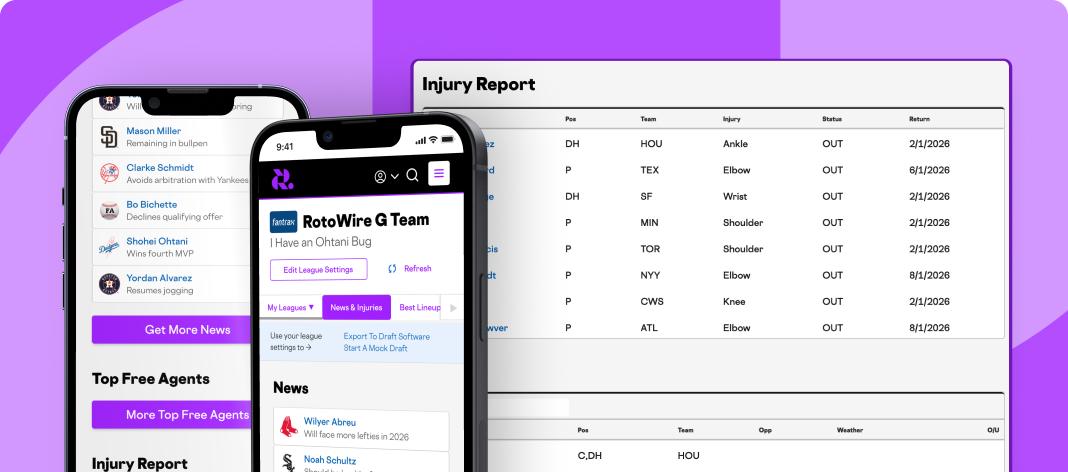
Using fantasy baseball custom rankings is one of the best actions that managers can take to push them ahead of the competition on draft day. Because most leagues have specific tweaks to their rules and settings, customizing rankings takes player projections and aligns them to how those MLB player stats will play in your particular setup.
The best part? It's simple to customize your rankings. As part of RotoWire's comprehensive fantasy baseball draft kit, you'll be able to select your league type, the stats your league will use, and the player pool you want ranked. Even small changes can make a significant difference in rankings, which is why they're necessary if you're serious about winning.
Custom Fantasy Baseball Rankings vs. Standard Rankings
Standard fantasy baseball rankings list players based on standard scoring settings. This means the five typical batting categories (batting average, home runs, RBIs, runs, stolen bases) and pitching categories (wins, saves, strikeouts, ERA, WHIP). But host sites have added so much customization over the last few years that leagues are more savvy and customized with the statistics that count. This includes on-base percentage, holds and quality starts, among others.
"Every fantasy league is different, and custom rankings take into account the specific settings that make a league unique. That could be the number of teams, scoring type, scoring categories/point values and much more. It could be as simple as a points vs. Rotisserie league in baseball," said RotoWire baseball expert Jake Letarski.
That's why using custom rankings
Using fantasy baseball custom rankings is one of the best actions that managers can take to push them ahead of the competition on draft day. Because most leagues have specific tweaks to their rules and settings, customizing rankings takes player projections and aligns them to how those MLB player stats will play in your particular setup.
The best part? It's simple to customize your rankings. As part of RotoWire's comprehensive fantasy baseball draft kit, you'll be able to select your league type, the stats your league will use, and the player pool you want ranked. Even small changes can make a significant difference in rankings, which is why they're necessary if you're serious about winning.
Custom Fantasy Baseball Rankings vs. Standard Rankings
Standard fantasy baseball rankings list players based on standard scoring settings. This means the five typical batting categories (batting average, home runs, RBIs, runs, stolen bases) and pitching categories (wins, saves, strikeouts, ERA, WHIP). But host sites have added so much customization over the last few years that leagues are more savvy and customized with the statistics that count. This includes on-base percentage, holds and quality starts, among others.
"Every fantasy league is different, and custom rankings take into account the specific settings that make a league unique. That could be the number of teams, scoring type, scoring categories/point values and much more. It could be as simple as a points vs. Rotisserie league in baseball," said RotoWire baseball expert Jake Letarski.
That's why using custom rankings matters. RotoWire runs MLB projections for a number of different stats, and customizing rankings will automatically sort players in terms of value based on what you choose. Simply put, standard rankings in a unique league don't give you the most accurate depiction of the best players.
Adjusting Rankings Based on League Settings and Scoring
Inputting your league settings is a critical aspect to fantasy baseball and custom rankings. Changing batting average to on-base percentage jumbles the rankings in an entirely new way, while adding holds+saves as a category, instead of just saves, will move closer rankings accordingly. It helps maximize your value, and it gives you a leg up on fantasy baseball managers who are going off standard rankings for a non-standard league.
"For a more advanced option that helps you track your draft, head to the RotoWire Fantasy Baseball Draft Assistant. Here, you can enter more options, like the number of teams and roster settings, to get even better rankings," Letarski said. "These are the rankings you'll want to use during your draft, as they will be far more accurate for your league than the generic ones found in the draft room."
One example is swapping saves for saves+holds, which gives more value to middle relievers and less to closers. In standard leagues, new Dodgers closer Edwin Diaz is ranked 85th. With custom rankings, he drops to 156. A manager using standard rankings will draft Diaz far too high, not knowing his value is diminished greatly by the presence of holds counting the same as saves.
Incorporating Position Scarcity and Roster Construction
Once you've customized your rankings by league type and scoring stats, users can export them into an Excel sheet. From there, managers can manually move players up and down based on personal preference or positional scarcity.
"For example, if you were just ranking all hitters based on batting stats, you wouldn't see many catchers in the top-200. However, due to positional scarcity, and depending on whether your league starts one or two catchers, they will be ranked accordingly among the rest of the player pool when utilizing custom rankings," Letarski said.
If you don't want to be left with table scraps at catcher, you'll likely move players like Cal Raleigh and William Contreras higher on your own rankings. Similarly, if you're in a keeper league, you can remove kept players to see more accurately what the draft board looks like. Managers can also tier players so they have a better idea of the value remaining on the board when they're drafting or bidding.
Using Projections, Tiers and Personal Risk Tolerance
Custom rankings go beyond just producing a list of players. Included in the rankings are projections of all players that managers can use when trying to hit benchmarks on certain stats that they believe will lead the fantasy league and generate more success. Tiering players also helps value beyond players pooled into one list.
This is where RotoWire's fantasy baseball draft assistant comes in handy. You'll be able to input your custom rankings and then track the draft through RotoWire's exclusive tool, all while seeing projections and tiers to help you make more informed decision about the players you target.
"Successful fantasy baseball managers tend to take a combination of established, proven talent and sleeper players that could break out," Letarski said. "If you have a high tolerance for risk, you'll be more likely to take younger or rookie players, or players with less of an established sample size of stats. You might even choose players who are injury-prone, betting on this being the year they manage to play a full season. These players likely come at a discount on draft day."
Refining Fantasy Baseball Rankings Throughout Draft Season
There is plenty of movement during the offseason and spring training. Rankings can, should and will change as fantasy baseball news trickles out about a late signing or trade, a relief pitcher securing a closer's role or a batter having a red-hot spring.
Managers will need to keep a close eye on all the happenings of the baseball world to keep their own custom rankings up to date, and RotoWire's team of experts makes daily updates to their rankings on the MLB projections revisions page.
If you've subscribed to RotoWire, a few days before the draft managers can export their rankings to an Excel file. This will allow them to make individual notes on players or adjust the actual rankings themselves to give them MLB projections, tiers, and rankings all in one spot to go and dominate their draft.