




With the 2025 campaign officially over, RotoWire has 2026 NFL projections live on the site for more than 500 players. As the person who does RW's first run of projections, I want to discuss why projections and rankings are best viewed as two separate things.
If you don't believe me, take a look at my PPR Top 300. My rankings track pretty closely with the projected top scorers in our NFL projections for the first 20 picks or so, but major differences begin soon thereafter and become increasingly frequent further down the rankings. Once we're past the Top 100, there may not even be a strong correlation between projected point totals and the order in which I rank players (even though it was my process that created those projected totals in the first place).
The reasons for this are useful to understand, even for those with no intention of creating their own rankings/projections. I'll go into more detail below, but I do think much of it can be boiled down to one simple idea/sentence:
We don't draft players for their median outcomes, especially after the first few rounds.
Thinking in Percentiles / Means vs. Medians
Season-long projections are estimates of medians, a.k.a., his 50th percentile outcome for fantasy if we were able to play/simulate the season 10,000 times. These projections often look more like 52nd or 55th percentile outcomes, in practice, because we're necessarily projecting a healthier world/season than what will happen in reality.


Crucially, we project most of the surefire starters at QB to play 16 games, because more than half of the starters with strong job security have made either 16 or 17 starts since the NFL moved to a 17-game schedule. It's a good median projection for the ~20 QBs locked into starting jobs, and the passing stats for these QBs then play a role in the projections created for pass catchers.
In real life, it's inevitable that some of the QBs we project for 16 games will suffer major injuries, and the average number of starts for the group as a whole (the mean) will be lower than both the real-life median and our projected median. A dozen QBs may finish above their median projection of 16 games, i.e., making all 17 starts, but that doesn't have nearly as much impact on the mean as when guys like Kyler Murray (five starts in 2025), Brock Purdy (nine starts) and Joe Burrow (eight starts) miss prolonged stretches.
We do make some effort to project injuries — e.g., Purdy and Burrow are projected for 15 starts instead of 16 in 2026, due to repeated health troubles — but the reality is that nobody wants to see season-long projections where we try to estimate each player's mean number of games played (even the most durable guys would be at something like 15.4, because one bad hit can wipe out a whole season). For players with secure roles, those 1st percentile outcomes (barely playing due to injury) have a far, far larger impact on projected means than the 99th percentile outcomes.
Take Amon-Ra St. Brown, with a 2026 projection of 1,250 receiving yards. The worst outcome for his 2026 receiving yards would be finishing 1,250 yards short of that number due to a major injury that keeps him off the field entirely. On the other hand, there's no scenario where he beats the number by 1,250, as doubling his projection would mean besting the single-season record by more than 500 yards.
The ever-present threat of a lengthy injury absence exerts far more influence on the mean projection than our best-case scenarios can exert in the other direction, yielding numbers that look oddly low to the casual observer (not to mention the difficulty of projecting a mean number of games missed for each player). Medians are what people want to see, rightfully, even if that leads us down a path that slightly underestimates the impact of major QB injuries, thereby giving a minor boost to league-wide passing/receiving stats.
When The Median/Projection Stops Mattering
For someone like ARSB, the 50th percentile outcome for his season (which we project at 1,250 yards) makes him an every-week starter in fantasy. When comparing him to other elite players for whom that's also true (i.e. all the other Round 1/2 picks), it makes sense to care about the median projection.
But what if we're comparing two players ranked outside of the Top 150? Their median outcomes are just slightly different versions of 'entirely useless for fantasy'. In fact, their 60th and 70th percentile outcomes probably don't matter either. When dealing with players ranked this low, we'll end up releasing them before we ever start them at least three-fourths of the time.
And even if they do eventually break through, it might be on someone else's roster. What does it matter if one RB is projected for 400 yards and the other for 350?
It could be that the guy projected for 350 yards is one injury away from a starting job in a top-10 offense, while the guy projected for 400 yards is a passing-down specialist on a bad team. That's perhaps a drastic example, but there are plenty of smaller examples when we consider the impact of age, player archetypes and team context — factors that can cause players with similar median projections to have vastly different ceiling scenarios.
We tend to think of our fantasy picks in Rounds 4-5 as starters, but it's really about a coin-flip at that point whether we're actually getting a reliable, quality starter. By Rounds 7-8, it's less than a coin-flip, and in shallow leagues there are players being drafted who aren't that much more valuable than the top options on waivers post-draft.
The way we prioritize reliability vs. upside depends on league size and settings, but nearly all formats incentivize increased risk-taking as a draft progresses. We want to target players with the best chance to crush ADP, not the players with the best chance to beat ADP. There are times when those two things line up, but more often it's the case that high-ceiling profiles are also low-median ones (and low-floor), i.e., risky.
If we simply compare players at each position by their median projections, we'll likely undervalue the risky profiles and overvalue the safe, boring veterans. Projections-based rankings generally have the same limitation, to varying extents.
Rookies usually fall in the high-risk, high-reward bucket, especially at this early juncture of the offseason when we don't know their draft position or NFL team. The same goes for impending free agents (e.g., Alec Pierce, Tyler Allgeier, Kenneth Walker), downfield pass catchers with uncertain QB situations (Justin Jefferson, Jordan Addison, DK Metcalf, etc.) and talented players coming back from major injuries (Quinshon Judkins, Cam Skattebo, Malik Nabers, etc.).
Many of those same players will still be the high-ceiling, low-median, low-floor profiles in their respective ADP ranges after free agency and the draft. This doesn't automatically make them good picks, however, especially if it's in the first few rounds where we still care about the difference between 20th and 40th percentile outcomes, et al.
Examples of Conflict Between My Ranks and Projections
- WR Jordyn Tyson (My Rank: WR18, Projection: WR25)
- WR Carnell Tate (My Rank: WR17, Projection: WR24)
Rookies are some of the first players that come to mind when we think about seeking out risk. Early best-ball drafts have Tyson and Tate going in the fifth round, which is late enough that the wide range of outcomes is a good thing (i.e., we care more about upside scenarios than median projections).
Early in the offseason, I'll also tend to be bullish on someone like Jordan Addison*, a good real-life player who has been held back by poor QB play and off-field problems. His median projection for 2026 may reflect those ongoing concerns, but what if he gets traded or the Vikings acquire a big upgrade at QB?
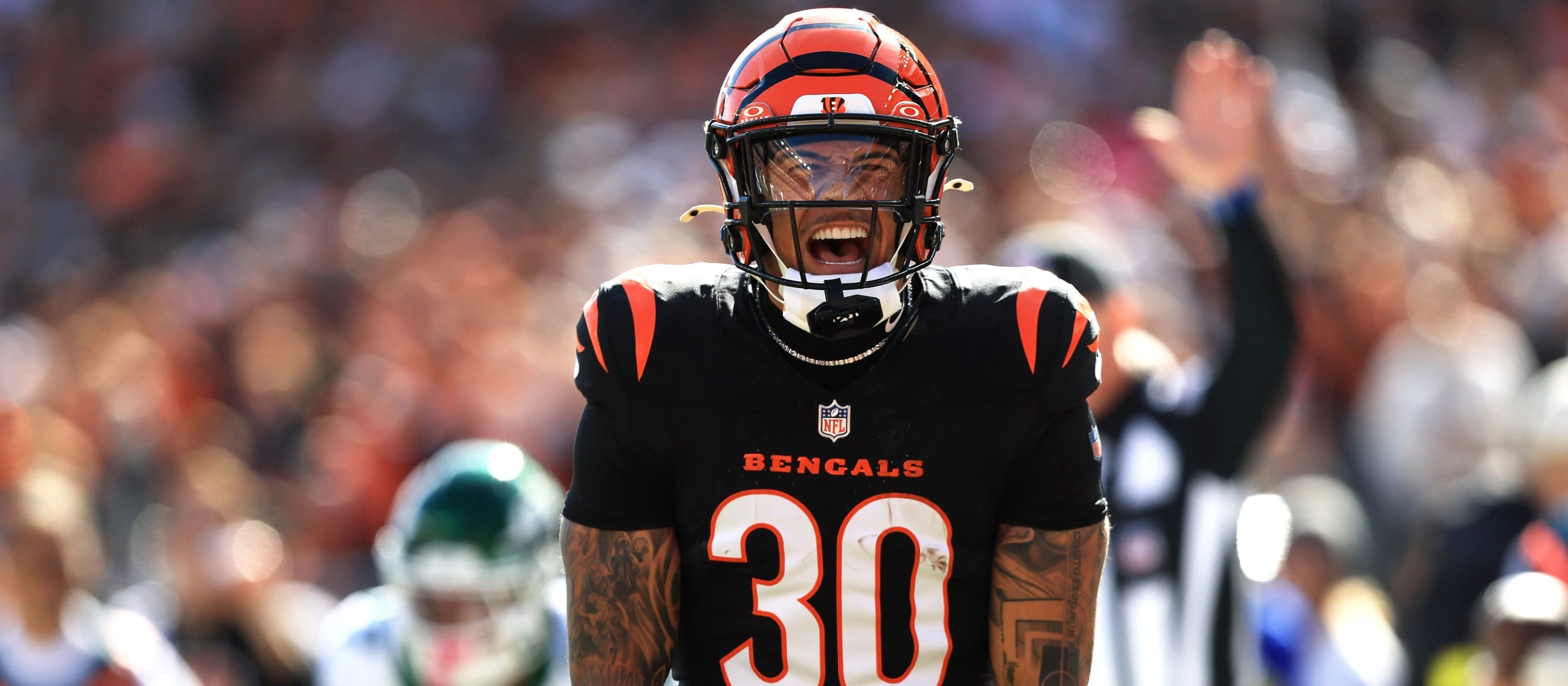
- RB Chase Brown (My Rank: RB16, Projection: RB12)
Brown is an odd case, where I view his downside risk as disproportionate to his upside risk, even though we've now seen two half-season stretches of elite production. I'd normally be targeting a player who has shown the ability to sustain an average around 20 PPR points per game for any significant stretch of time, but Brown sets off red flags because he hasn't been all that good of a player in real life.
His combination of speed, durability and passing-down skills definitely has value, but he's not a great runner, which creates considerable risk for major role decline in the future. Our projections account for that risk, to a degree, with Brown projected solidly below where he's going in early drafts on Underdog (around the 2/3 turn). My personal rankings then put even more weight on that risk than the projections do, which leaves Brown at the 3/4 turn (two full rounds after his best-ball ADP).