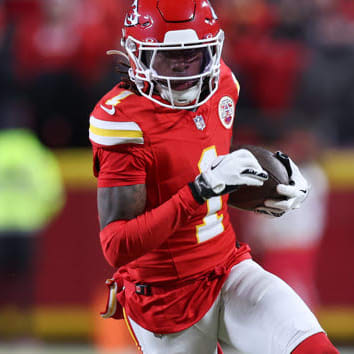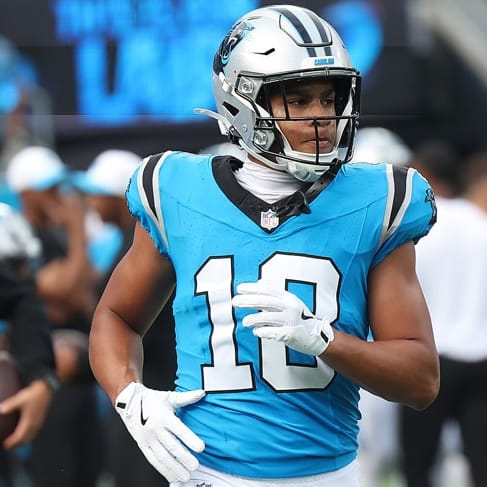

This dynasty football trade strategy article identifies four players to buy and four players to sell.
Dynasty football is mostly about the drafts and the blockbuster trades, but it's also important to constantly pad your margins by churning the bottom of your roster, accumulating small improvements to eventually leverage into a meaningful advantage.
Each of the players in this article has some amount of value – that's why it assumes they are worth buying and can feasibly be sold. The near- and long-term fluctuation between these players provides profiting opportunities for those who time the waves correctly.
The 'buys' need to be for advantageous prices, and the 'sells' require appropriate compensation before letting them go. Don't buy or sell for just anything – it only conditionally makes sense to buy or sell these players in dynasty.
The players are listed in loose descending order of present fantasy cost within their grouping.
PLAYERS TO BUY
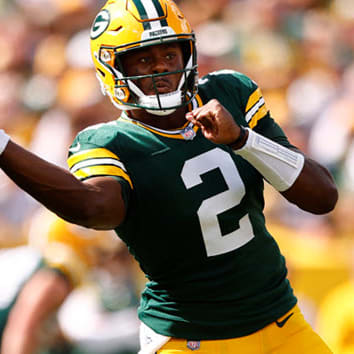
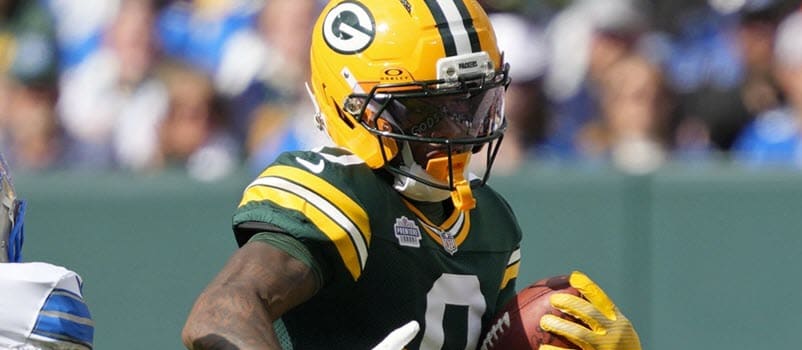
Matthew Golden, WR, GB
As much as Golden's rookie year was disappointing and as much as he might never be truly free from Matt LaFleur's neurotically horizontal wideout rotations – did you see which team Malik Heath is on nowadays? – there's a difference between noting those details and conflating them with Golden playing poorly, because Golden more so looked at least decent whenever he saw a real opportunity.
With all that said, Golden's rookie-year numbers are the sort of bad that objectively group him with past outcomes that are nearly all disastrous. When you set the historical query it's basically all horrific results. There might be Golden owners out there who somewhat reasonably assume he too is no good.


If that describes the Golden owner in your league, then it might be worth checking their asking price. The problem with deferring to past outcomes as the sole criterion, sizable and rightfully concerning as that sample might be, is that almost none of the players in that sample were subjected to the same conditions as Golden. LaFleur was never going to give Golden a chance to earn starter-level snaps with all of Romeo Doubs, Christian Watson and Jayden Reed healthy.
But now Dobbs should walk in free agency, and Golden is still a good prospect. Dontayvion Wicks has absolutely killed Green Bay the last two years and it would be shocking if they continued to limit Golden's snaps to clear out room for an obvious backup like Wicks.
Even in the best-case scenario Golden likely won't ever be dominant – he's more like a fast Marvin Jones than a Joey Galloway – but if the Golden owner in your league is trying to cut bait then you might want to be the person who swoops in for quality depth with starting upside.
Ryan Flournoy, WR, DAL
Flournoy will never be confused for a talent on the level of CeeDee Lamb or George Pickens. That fact and Flournoy's poor draft capital should make Flournoy affordable in most formats.
Flournoy produced well enough in the NFL that there's reason to reconsider his prospect profile, which was otherwise challenged by his age (25-year-old rookie) and low level of collegiate competition (Southeast Missouri State). Flournoy's 477-snap sample in 2025 is full of good stuff, and that production gives us reason to suspect a sound skill set in addition to his unambiguously great athleticism (4.44-second 40, 39.5-inch vertical, 132-inch broad jump).
If Flournoy has the sum of skill set and athletic talent to continue producing like he did in 2025 then it would make him something like a handcuff asset at wide receiver – one who can plug in as an easy fantasy WR3 at worst in the event that Lamb or Pickens are unavailable. As much as Flournoy can't be anything like Lamb or Pickens, he might be able to be something like Dallas' latest Laurent Robinson.
Flournoy would be the ideal player to demand as a throw-in before accepting a trade – a potential asset on par with a coveted rookie draft pick, yet one who the current owner probably doesn't care much about.
Jordan James, RB, SF
As much as it's not great that James didn't play on offense his rookie year – three snaps and no touches to be precise – it's also easy to look at his situation and suggest his inactivity was for reasons outside his control.
James received praise from Kyle Shanahan and Klay Kubiak during training camp but shortly after suffered a knee tweak and then a broken finger, which in tandem wiped out most of his training camp. Perhaps James might have stolen some playing time from designated RB2 Brian Robinson if the rookie hadn't missed the vast majority of training camp, but by the time he returned from the broken finger in-season the 49ers had no time or attention to give to a developmental RB3.
Christian McCaffrey will turn 30 in June and has shouldered a mammoth from-scrimmage workload through his career. Robinson isn't interesting even by backup standards and the 49ers might move on. Even if the 49ers bring back Robinson or some other veteran backup to replace him, it's worth a price check on James in your dynasty leagues because a healthy training camp in 2026 could make all the difference.
Charlie Kolar, TE, BAL
Kolar is an unrestricted free agent and is a candidate to either leave or stay in Baltimore, depending on which teams offer what. No matter whether he stays or goes, Kolar is worth stashing to your roster at a price that is likely free or close to it in most 1TE formats. He's certainly worth targeting in TE-Premium leagues too, depending on the price.
Kolar is likely a quality starting NFL tight end who hasn't been given the chance to prove it yet. That might change in 2026.
If Isaiah Likely re-signs with Baltimore then it makes it that much more likely that Kolar is going elsewhere. If Likely signs with another team then it raises the serious suspicion that Baltimore re-signs Kolar, in theory as a TE2 along with Mark Andrews.
Either scenario works for a potential breakout script – if another team signs Kolar then it might be as a starter, and if Likely is gone from Baltimore then Andrews is a manageable remaining obstacle. In any event, if Kolar gets a three-down role from some team he could break out in a big way in 2026.
Kolar is widely misunderstood as a blocking tight end, just because it's all Baltimore has allowed him to do to this point. The route-running reps at tight end were reserved for Andrews and Likely, leaving just blocking scraps for Kolar to claim otherwise.
It reflects very well that Kolar earned those blocking-specialist reps, because as a prospect Kolar was described as the exact opposite – a pass-catching specialist who was considered a liability as a blocker. Kolar was a uniquely productive pass catcher at Iowa State, but his blocking was held against him.
If Kolar is a standout blocker now and was a good receiver all along, shouldn't he be a starter? Probably, in my opinion. Now we wait to see how the NFL sees it. But Kolar has received praise for his blocking, and at 6-foot-7, 248 pounds he ran a 4.62-second pro day 40 while logging a strong agility score (11.3). To me he's one of the best free agents on the market.
PLAYERS TO SELL
Kyle Monangai, RB, CHI
Monangai is a solid player and no one should sell him for cheap. Just the same, it's possible he's close to maxed out already. If there are dynasty owners who more so project growth for Monangai because he was a rookie last year – normally a reasonable enough reflex – then those people might be willing to pay up enough to make it worth selling Monangai now.
Monangai's strengths are perfectly clear, and durable: he's a consistent runner between the tackles who runs with patience, vision and anchor. He also never fumbles, never has. Dependable running (including short yardage) and automatic ball security are two traits that Monangai will carry into the indefinite future.
The problem is that those are his only strengths, and in passing-down situations especially Monangai does not grade so well. He really struggled as a receiver to the point that Chicago basically compelled to reallocate those targets to someone else, and as a blocker Monangai isn't likely to ever be better than tolerable.
Monangai is as script-dependent as any running back in the league, and even if D'Andre Swift leaves the Bears in upcoming years there will always be some passing-down replacement to pose the same roadblock to playing time. Monangai is almost strictly a closer at running back, which means anytime the Bears are losing he's liable to disappear.
Theo Johnson, TE, NYG
Johnson is a very toolsy tight end and can make acrobatic plays at times, yet his production in the NFL and in college both hint at a player whose skill set lags behind his otherwise excellent athleticism. What allowed him to provide solid fantasy value in 2025 is the fact that he played so many snaps – 869 in just 15 games. That's a big snap count for 17 games, let alone 15.
Johnson 74 targets looks less impressive when you weigh it against those 869 snaps. The target rate is not very good, and it's not because Johnson was blocking so much. Daniel Bellinger handles most of those reps.
If Johnson's per-snap target rate and his per-target efficiency don't both improve then I think he's liable to lose playing time in passing situations in the future. Even if that isn't true, it's still the case that Johnson needs to improve both his per-snap target rate and his per-target efficiency or else incidental fluctuation in yearly snaps will yank him out of the top 15 during his down years.
Remember how Logan Thomas finished as the PPR TE3 in 2020? He needed 1,009 snaps to pull that off, and he never logged more than 700 snaps in a season after that.
Braelon Allen, RB, NYJ
Highlight and preseason watchers almost all agree that Allen is the next Derrick Henry or some such thing. Derrick Henry doesn't run a 4.8 40 – these details matter. This is a dud that should be sold before the season.
I'm biased to describe Allen as a dud asset, but it's not any more hysterical than declaring him better than Breece Hall based on an untouched preseason touchdown. No Allen critic is more outlandish than any one of Allen's fans.
Not only is Allen nowhere near Hall's level, it's clear by now that Isaiah Davis is also better. It was also fairly clear that Davis was better than Allen out of college, despite the fallibility of the Jets' prior regime. A fair comparison for Allen would be C.J. Ham or, if we're being incredibly generous, Jacksonville Greg Jones.
The time where everyone understands these facts is rapidly approaching, and the time to cash in on the Allen myth is dwindling. It's possible that Allen peels off a few preseason plays to get the hype going again, but it's also possible the Jets get to camp and wonder why anyone ever thought he was better than Davis.
Tez Johnson, WR, TB
Johnson clearly has something to offer at the NFL level, and he should be a quality contributor for some number of years. The problem is his contributions are comparable to a utility infielder in baseball or something like that – timely and legitimately useful as they might be, the flickers of production for Johnson unfortunately have no room to scale for upside.
It's true that some otherwise subpar utility infielders end up useful in fantasy for various fluky reasons, but the playing time variable is one thing they all need. Whereas untimely injuries can force a baseball team to use a part-time player in a full-time role for weeks on end, thus making certain utility players eligible for promotion they otherwise couldn't seize by merit, any three-down role for Johnson would occur on an emergency basis.
At around 160 pounds and lacking raw speed (4.51 40 at 154 pounds), there simply isn't any room for Johnson in the game plan outside of hurryup and obvious passing situations. He's too much of a liability on run downs and not dominant enough of as a receiving specialist to make up for it.
There were a few times where Johnson operated as a three-down receiver for the Buccaneers last year, but consider the injuries they were dealing with. The Buccaneers were without all of Mike Evans, Chris Godwin and Jalen McMillan, and even then Johnson was only vaguely productive, largely propelled by big plays and touchdowns that predictably dried up as his exposure heightened.
Someone might look at Johnson's otherwise decent rookie year and suspect it means there is future upside. There likely is not.